
By Dan Varroney
A job that never gets created does not come with a layoff notice. There is no announcement when a business owner postpones an expansion, leaves a machine unordered, or decides another employee will have to wait. Yet those quiet decisions shape whether a family gets ahead, a community gains opportunity, and America builds the capacity for stronger economic growth.
America’s job creators live with risk every day. They compete for customers, train employees, manage cash flow, and put their own resources behind ideas that might fail. What they need from public policy is a dependable foundation for decisions whose consequences extend years beyond the next election.
The road to sustained 3 percent growth runs through those decisions. Certainty and consistent policy help business owners move from seeing an opportunity to acting on it.
Consider a small manufacturer with enough customer interest to justify another production line. The owner must price equipment, arrange financing, recruit workers, and estimate how long the investment will take to pay for itself. Each commitment begins before the additional revenue arrives.

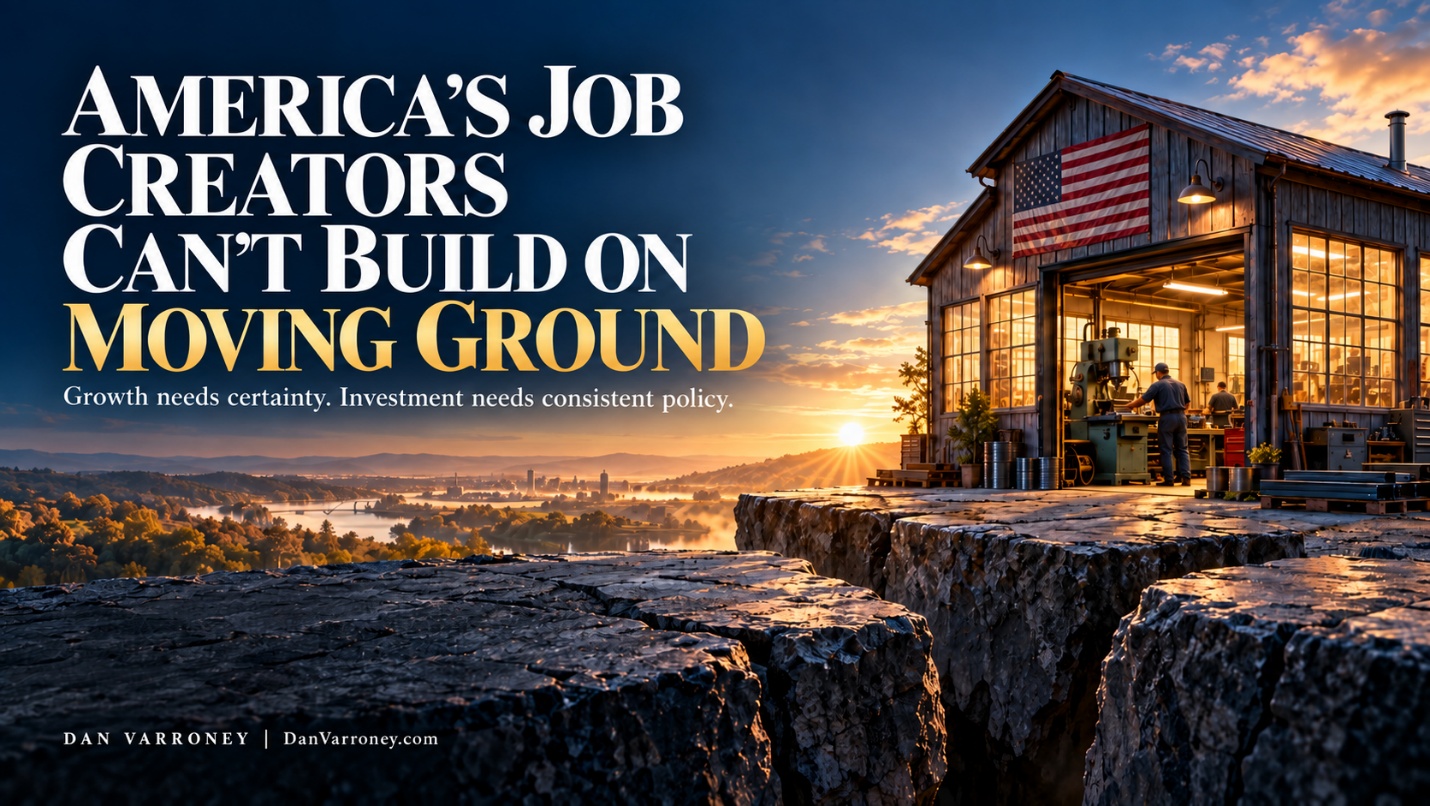
Now introduce uncertainty about the cost of imported components, the requirements for operating the equipment, or the timing of an approval. The opportunity may still look promising, but the calculation becomes harder to trust. Waiting starts to look responsible.
For the owner, that pause can protect the business. For the prospective employee, it means an opportunity remains out of reach. For the equipment supplier and the local contractor, it means another order stays on the drawing board.
Federal Reserve researchers have described how uncertainty can delay investment and hiring, encourage more cautious household spending, and tighten credit conditions. That helps explain why policy unpredictability reaches beyond the company making the initial decision. Its effects can travel through customers, suppliers, lenders, and communities.
A growth strategy must address that hesitation. An incentive has less power when the business owner cannot confidently estimate the conditions surrounding its use.
In this series, I have emphasized four foundations for small-business growth: workforce, regulation, reinvestment, and capital. Consistent policy strengthens each because business owners experience them together. A financing commitment cannot solve an unpredictable approval process, and an available worker cannot operate equipment that never gets purchased.
Workforce development requires continuity. Employers and educators need time to build training programs, recruit participants, and prepare people for actual openings. Programs should be judged by skills gained, placements, and advancement, with sufficient stability for successful partnerships to mature.
Regulation should make obligations understandable and implementation predictable. Business owners need clear guidance, coordinated requirements, and reasonable transition periods when rules change. Protecting employees, customers, and communities works better when employers can understand their responsibilities and plan to meet them.
Reinvestment depends on a credible planning horizon. The tax treatment of equipment, research, and expansion should support decisions made over the useful life of an investment. Policymakers should weigh the disruption caused by repeated changes, including the time owners spend revising plans instead of executing them.
Capital depends on that same horizon. A lender evaluating an expansion needs a credible account of future costs and revenue. Clearer policy assumptions can make that evaluation more reliable, although they cannot substitute for customer demand, sound management, or a viable business model.
Put these pieces together and the practical objective becomes clear: give a capable business owner a reasonable basis for saying yes.
Consistency does not require government to preserve a policy that fails. Technology changes, evidence develops, and legitimate public needs require a response. The obligation is to make improvement understandable and orderly.
That means explaining the problem being addressed, consulting the people responsible for implementation, announcing realistic effective dates, and measuring results. When changes affect investments already underway, policymakers should consider appropriate transition provisions so owners have time to adapt.
Scheduled reviews can help policies evolve without creating constant anxiety about their future. The review process should be transparent, with decisions made early enough for employers to prepare. A review deadline should prompt evaluation, rather than become another recurring cliff that businesses must plan around.
The same discipline belongs at every level of government. A clear federal rule offers limited reassurance when state requirements conflict or local decisions arrive on an unknowable schedule. Coordination is part of creating an environment in which investment can proceed.
Business owners and trade associations can make the case for consistency more concrete. Bring policymakers examples of decisions waiting to happen: the expansion, the apprenticeship class, the additional shift. Explain which unresolved requirement affects the decision and what clarity would allow the company to do next.
The most persuasive evidence connects policy to people. Show how an uncertain timetable affects a prospective employee, how a changing requirement alters an investment calculation, or how conflicting instructions absorb the owner’s working day. Those details turn an abstract debate into a discussion about consequences.
Trade associations can identify recurring problems across companies and propose workable solutions. Business leaders, in turn, should maintain scenarios for changing conditions so they can act when opportunities become viable. Public policy can reduce avoidable uncertainty; leadership must still manage the risks that remain.
America’s capacity to grow is built one commitment at a time. The next employee, the next production line, and the next generation of business owners all need someone willing to invest before the outcome is assured. Give America’s job creators clear rules and policies they can plan around, and more of them can make that commitment. Working families deserve the opportunities that follow.
Understand what today’s economy means for tomorrow’s decisions. Subscribe to receive Dan Varroney’s monthly articles on economic growth, small business, and the policies shaping opportunity for working families.
Bring this conversation to your next leadership meeting or conference. Dan Varroney helps business and trade association leaders understand the forces shaping growth, investment, and small business. Explore Dan’s speaking programs.
Dan Varroney is the author of Rethinking Economic Growth and founder and CEO of Potomac Core.