
By Dan Varroney
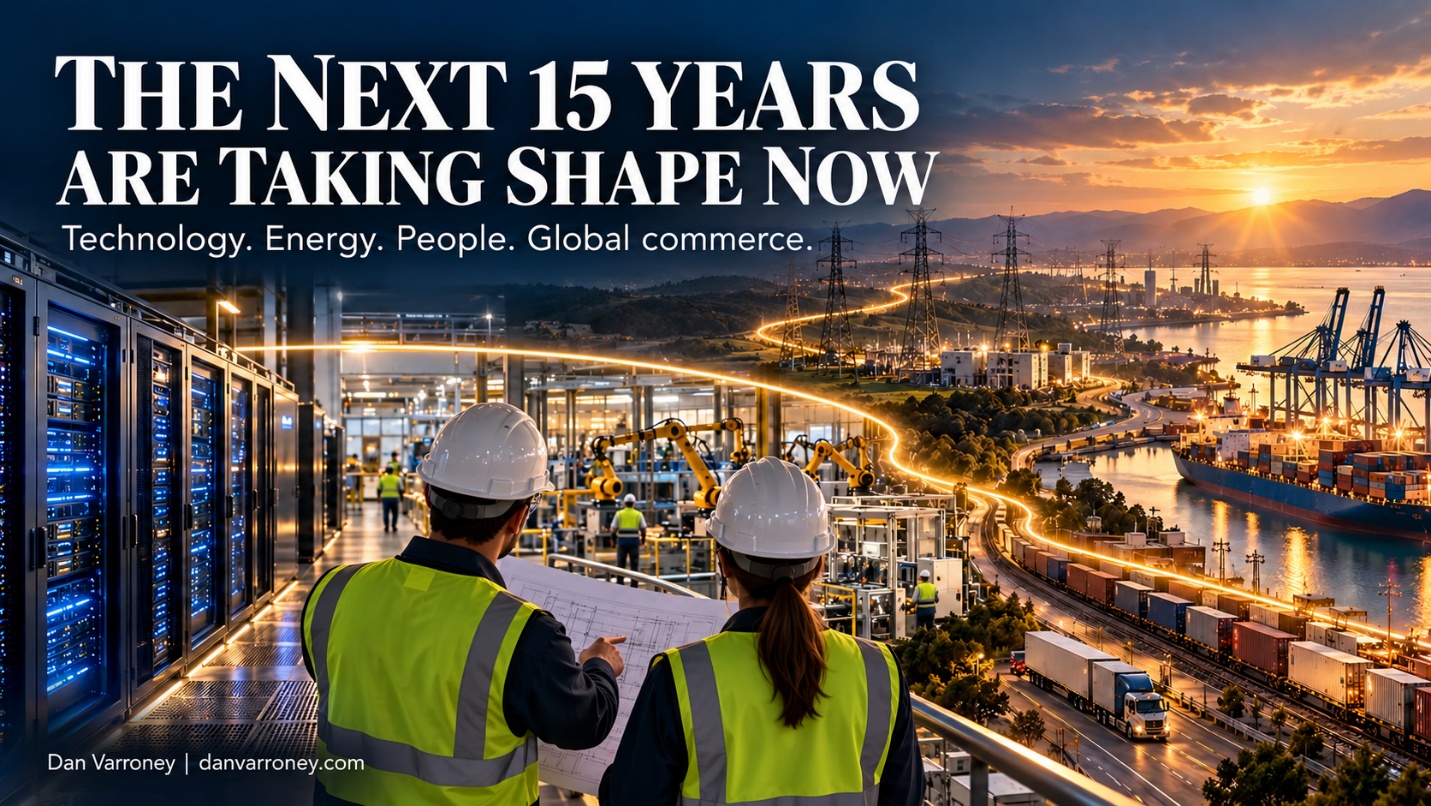
A business owner buying equipment today is making a decision about an economy that may operate differently before that equipment wears out. A young person choosing a career is preparing for work whose responsibilities are already changing. A community expanding its power supply or building housing is influencing whether future employers and workers can locate there. The next 15 years of American growth are taking shape in decisions being made now.
In my earlier article, Economic Outlook Speaker: Booms, Busts & What Comes Next, I examined the historical patterns behind economic transformation. But what distinguishes this era is the combination of technologies that expand human capability, physical systems that take years to build, an aging population and changing global trading relationships.
These forces operate on different clocks. Software can change in months. Preparing skilled workers takes years. Energy infrastructure can shape a region for decades. The distance between those clocks will help determine which businesses grow and how much progress reaches working families.
Artificial intelligence illustrates the first change. Earlier automation concentrated heavily on physical tasks and routine information processing. Generative AI extends that reach into drafting, analysis, software development and other knowledge work, potentially making capabilities accessible to businesses that previously could not afford them.
An early study published by the National Bureau of Economic Research found that an AI assistant increased customer support productivity by about 14 percent, with the largest benefits among less experienced and lower-skilled workers. That finding suggests technology can help people apply useful knowledge faster, although it does not establish comparable gains across every occupation.
For a small business owner, the opportunity is practical: less time preparing routine documents and more time serving customers or pursuing orders. The test is whether the improvement justifies the cost, including checking accuracy and protecting customer information.
The second change is that digital capability carries substantial physical requirements. In its 2025 Energy and AI report, the International Energy Agency projected that global electricity consumption by data centers would more than double by 2030. It also noted that new transmission lines can take four to eight years to build in advanced economies. Technology can advance faster than the systems supporting it.
That tension reaches beyond technology companies. A region attracting investment still needs dependable power, skilled tradespeople and housing within reach of workers. Manufacturers, utilities, construction firms and local governments must make decisions that affect one another. Growth depends on whether these pieces arrive together.
Demographic change adds another dimension. An aging population changes both the services Americans need and the workforce available to provide them. The Bureau of Labor Statistics projects that healthcare and social assistance will account for roughly 37 percent of new jobs between 2025 and 2035, driven partly by population aging and chronic health conditions.
Better tools could help employees spend more time on work requiring judgment, relationships and care. But some workers will face displacement and difficult transitions. Employers must also consider how people enter a profession when technology performs tasks that once trained beginners.
Meanwhile, businesses are reconsidering where they produce, source and invest. The International Monetary Fund has described an economy adjusting to greater protectionism and fragmentation, with trade-offs between resilience and efficiency. Supplier reliability, market access and political disruption now demand careful consideration alongside price.
None of these forces is entirely without precedent. Their combination matters because businesses must adopt new capabilities while reconsidering the workers, infrastructure and trading relationships those capabilities require. Three planning horizons help clarify the stakes without pretending to predict the future.
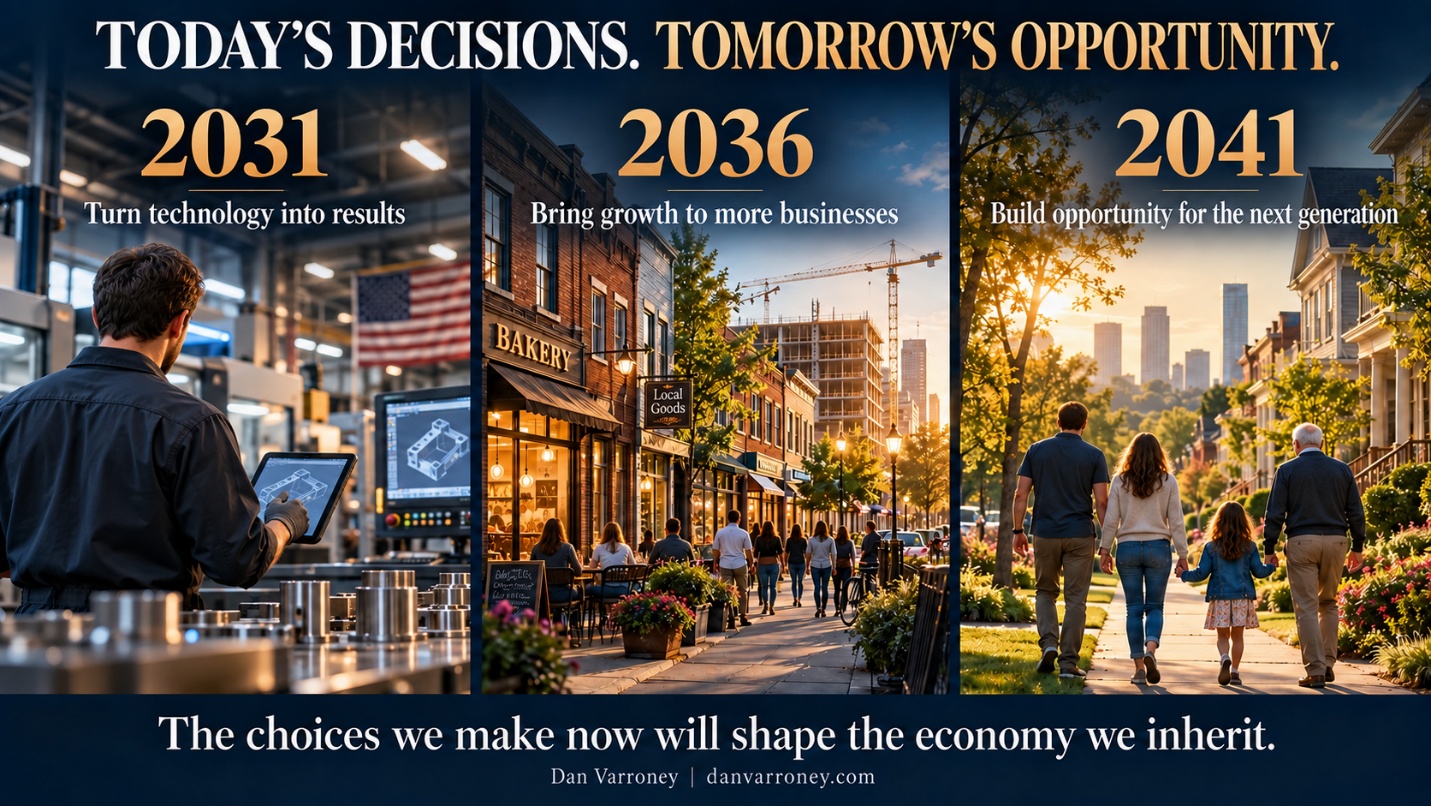
Five years from now, in 2031, the test will be whether experimentation has become reliable business improvement. Have new tools reduced errors, improved service or increased output? Have employers prepared workers for more valuable responsibilities? Have communities delivered the infrastructure needed to support investment?
Leaders should start with specific operating problems, establish what improvement would look like and expand when results justify it. Waiting for complete certainty carries a cost, but so does committing heavily before understanding how a technology works in the business.
Ten years from now, in 2036, the question will be how widely those gains have spread. A few highly productive companies could prosper while others struggle. A stronger outcome would put useful capabilities within reach of smaller manufacturers, contractors, distributors and service businesses nationwide.
Trade associations can help through practical training, useful standards and partnerships with educators, technology providers and infrastructure leaders. Their opportunity is to help an entire industry adapt, especially businesses without large research or training departments.
Fifteen years from now, in 2041, the test will be whether this transformation has improved the next generation’s prospects. Can workers build careers that support a family? Can entrepreneurs enter established markets and compete? Have communities gained lasting productive capacity? Those measures will matter regardless of how technology evolves.
That longer view should influence policy now. Reliable rules, timely permitting, workforce preparation and sound public finances help businesses make commitments whose returns unfold over years. Protecting people and improving the process of building a more productive economy must advance together.
America has reasons for confidence: entrepreneurs willing to take risks, workers capable of learning and institutions that bring people together to solve problems. The defining achievement of this era should be a country where more people can build a business, earn a better living and see a future for their children. We are making the decisions that will determine that outcome now.
Understand what’s changing. Prepare for what comes next.
Receive Dan Varroney’s monthly economic insights on what today’s developments mean for your business, your industry and the future of American growth.
Sign up for monthly economic insights.
Bring this economic perspective to your next leadership meeting or conference. Dan Varroney helps business and trade association leaders understand the forces shaping investment, small business, working families and long-term growth. Explore Dan’s economic keynote topics.
Dan Varroney is an economic strategist, founder and CEO of Potomac Core, and author of Rethinking Economic Growth.