

Every generation believes its economic transformation is unprecedented. The railroad compressed distance. Electricity reorganized production and daily life. The interstate highway system connected markets at national scale. The internet changed how information, capital, and commerce move. Today, artificial intelligence, advanced manufacturing, biotechnology, quantum computing, energy, and new infrastructure are attracting extraordinary investment and equally extraordinary expectations.
The technologies change, but the pattern beneath them is remarkably consistent. America’s greatest economic expansions did not begin when everyone agreed about the future. They began when investment moved ahead of certainty, infrastructure expanded, businesses learned how to use new capabilities, and public policy either reinforced productive growth or allowed momentum to outrun the fundamentals.
That historical pattern matters because leaders are again being asked to make consequential decisions before the outcome is clear. Is today’s investment surge building the foundation for a durable expansion, or are expectations moving faster than productive capacity? Which developments will reshape an industry, and which will become expensive distractions? What should leaders invest in now, and where should they remain disciplined?
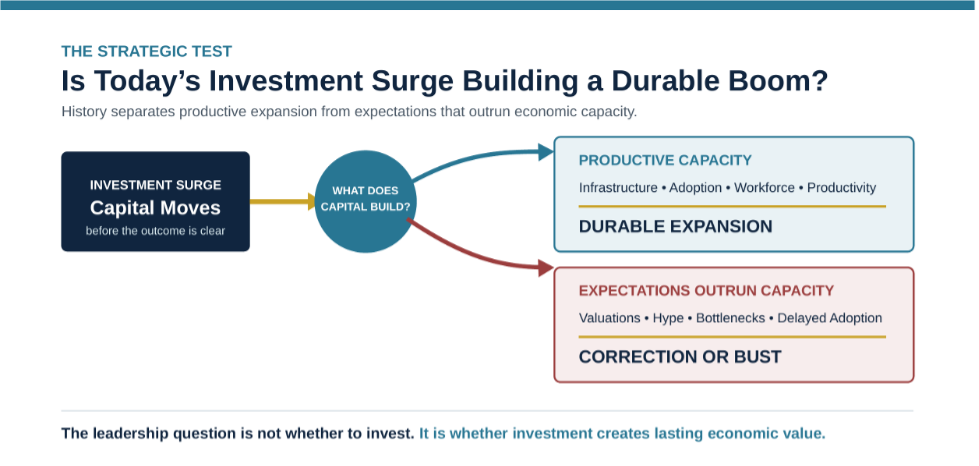
Economists can describe current conditions, but history helps leaders interpret them. A boom becomes durable when capital creates productive capacity rather than simply increasing valuations. Railroads created lasting value when they connected farms, factories, cities, and ports. Highways transformed commerce because vehicles, housing, logistics, and consumer markets grew around them. The digital revolution accelerated when computing power, broadband, software, and business adoption began reinforcing one another.
The same test applies today. Investment in artificial intelligence will matter most when it improves productivity across the broader economy, not only when it raises the value of technology companies. Advanced manufacturing will become a growth engine when new facilities are matched by skilled workers, reliable energy, modern permitting, transportation, and strong domestic supply chains. Biotechnology and quantum computing will require long time horizons, specialized talent, research infrastructure, and public confidence.
History also shows why booms become vulnerable. Capital can move faster than customers adopt a technology. Infrastructure can lag behind demand. Workforce shortages can constrain expansion. Policy uncertainty can delay projects that have already been announced. Eventually, enthusiasm collides with the economy’s ability to convert investment into useful output.
That collision does not mean every boom ends in collapse. Corrections often separate durable investments from speculative excess. The railroad industry experienced repeated financial failures, but the network it built changed the nation. The early internet economy produced spectacular losses, yet the infrastructure, talent, and business models that survived became the foundation of the modern economy.
For leaders, the lesson is not to predict the exact moment a boom will peak or a correction will begin. The more valuable discipline is to identify the conditions that determine whether growth can endure. Is investment creating real capacity? Is the necessary infrastructure being built? Are customers adopting the technology in ways that create measurable value? Are productivity gains spreading beyond a small group of companies? Are federal, state, and local policies aligned with expansion?
Those questions move the conversation beyond economic headlines. They help an industry distinguish temporary excitement from consequential change. They also connect the economic cycle to decisions about capital, workforce, partnerships, advocacy, and risk.
This is where history becomes practical. It gives leaders a framework for interpreting the present without pretending the future is predictable. It reveals the forces that built earlier periods of American growth, the warning signs that appeared before major corrections, and the decisions that allowed some industries to emerge stronger.
America may be entering another important growth era. The combination of technological innovation, capital investment, industrial capacity, and infrastructure could produce lasting gains. But history tells us that a promising technology is only the beginning. Durable growth must be built through adoption, productivity, workforce capability, and public policy that supports investment while maintaining discipline.
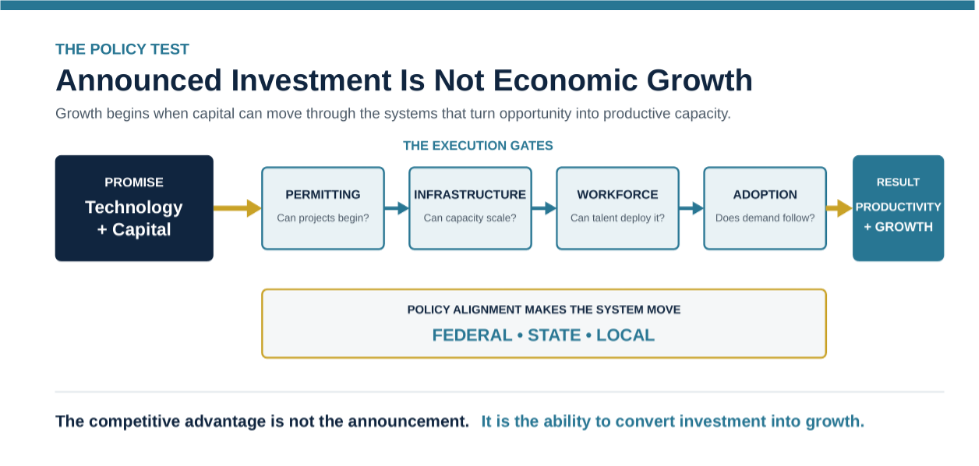
This also changes the policy test. Announcing investment is not the same as creating growth. Tax policy can encourage capital formation, but permitting determines whether facilities are built. Research funding can advance discovery, but education and immigration policy affect whether the necessary talent is available. A durable boom requires federal, state, and local systems to work together.
In the articles that follow, I will examine these tests one by one: the difference between an investment boom and a bubble, the role of infrastructure, the productivity evidence leaders should watch, and the policy choices that will determine whether today’s momentum becomes another era of American growth. The next economic cycle is already taking shape. The leaders who understand the pattern will be better prepared to decide what it means for their industry and what they should do next.
Continue the series: The Boom Is Real. That Does Not Mean Every Bet Will Pay Off.
Bring this economic perspective to your next leadership meeting or conference. Dan Varroney helps business and trade association leaders understand the forces shaping investment, productivity and economic growth. Explore Dan’s economic keynote topics.
Dan Varroney is an economic strategist, founder and CEO of Potomac Core, and author of Rethinking Economic Growth.