
America regularly celebrates small business as the engine of the economy. The description is accurate, but praise is not a growth strategy. If the country wants stronger and more consistent economic growth, it must address the conditions that determine whether small and mid-sized businesses can invest, hire, modernize, and expand.
Small businesses account for 43.5 percent of U.S. gross domestic product, employ 45.9 percent of private-sector workers, and have produced 60 percent of net new jobs since 1995. When that much of the economy hesitates, the entire economy slows. When small businesses move forward with confidence, growth spreads through communities, supply chains, and industries.
For Rethinking Economic Growth, I conducted nearly fifty hours of interviews with business leaders across a wide range of industries. Their companies produced different products, served different customers, and operated under different regulations. Yet the same constraints surfaced repeatedly: workforce shortages, regulatory burden, tax structures that affect reinvestment, and access to capital.
That repetition revealed an important truth. Many small-business growth problems are not isolated weaknesses inside individual companies. They are structural barriers that appear across industries and often reinforce one another.
A company may have strong demand but lack the skilled workers needed to expand. It may need new equipment but face expensive capital and uncertain cash flow. It may want to hire, yet hesitate because tax treatment or regulatory requirements make the next investment difficult to evaluate. A permitting delay can postpone modernization, which limits productivity, which makes it harder to raise wages and compete for talent.
These challenges cannot be solved through a collection of disconnected programs. America needs an actionable small-business growth roadmap built around four linked levers: workforce, regulation, reinvestment, and capital.
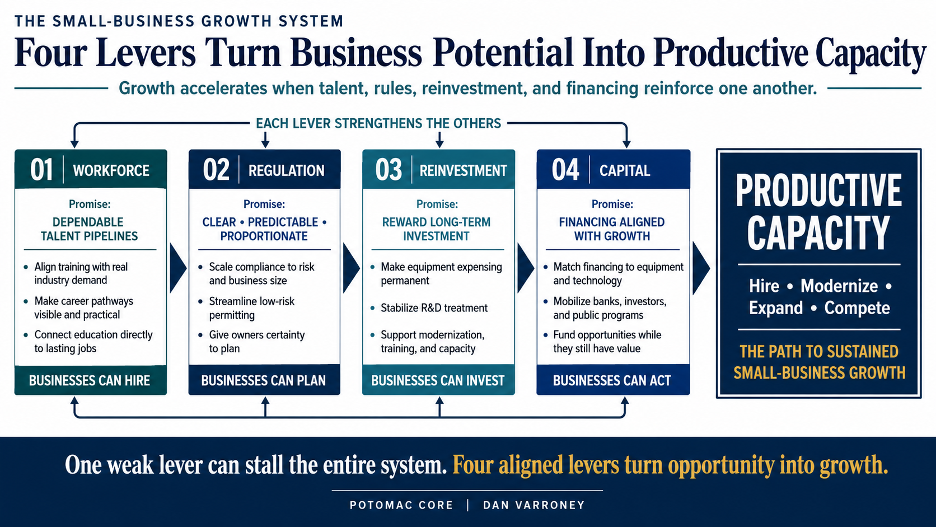
The first lever is workforce. Small businesses need dependable talent pipelines, not periodic workforce initiatives that disappear when funding changes. Employers, trade associations, community colleges, high schools, workforce boards, and state and local leaders should align training with actual industry needs. Career pathways must be visible, practical, and connected to jobs that offer long-term opportunity.
The second lever is regulation. Small businesses do not need the absence of rules; they need rules that are clear, predictable, and proportionate to risk. Regulatory complexity imposes costs that larger companies can spread across more employees and revenue. Policymakers should scale compliance requirements, streamline low-risk permitting, provide standardized tools, and give businesses enough certainty to plan investments.
The third lever is reinvestment. Tax policy should consistently reward companies that purchase equipment, modernize facilities, adopt technology, train employees, and expand capacity. Permanent expensing and stable treatment of research and development help owners make long-term decisions. Temporary incentives may accelerate activity briefly, but predictability produces sustained investment.
The fourth lever is capital. Access to financing determines whether businesses can act while an opportunity still has value. Traditional lenders, equipment-finance companies, community banks, investors, and public programs all have roles to play. The goal should not be capital for its own sake. Financing should be aligned with the equipment, technology, workforce, and capacity investments that allow a business to grow.
The roadmap also requires collective action. Individual owners are often consumed by operating their businesses and serving customers. Trade associations can aggregate their experiences, identify common barriers, organize credible data, and advocate at the federal, state, and local levels. Financial institutions can become growth partners rather than transaction providers. Educators can build programs around demonstrated demand. Policymakers can evaluate whether regulations and incentives work together or at cross-purposes.
This is not a call for government to direct business decisions. It is a call for the public and private sectors to understand how their decisions affect nearly half of the economy. Small businesses are resilient, but resilience should not become an excuse for making growth unnecessarily difficult.
The debate separates these issues. Workforce policy is discussed without capital. Regulation is debated without considering reinvestment. Tax incentives are evaluated without asking whether permitting or labor constraints will prevent businesses from acting.
This article opens a series examining each part of the roadmap. The next installments will show how workforce, regulation, reinvestment, and capital interact; what business and government can change; and how trade associations can turn thousands of individual constraints into a coordinated growth agenda.
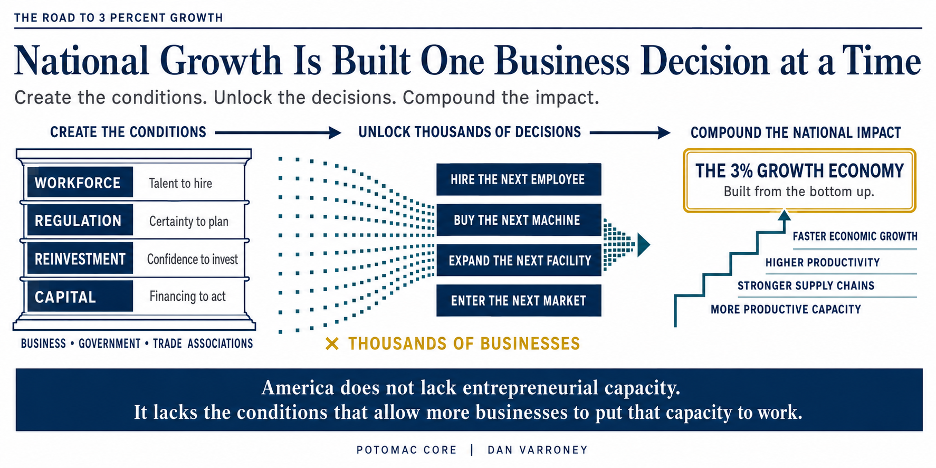
Consistent 3 percent economic growth will not come from one technology, one industry, or one policy. It will come from thousands of businesses making the next investment, hiring the next employee, purchasing the next piece of equipment, and entering the next market. America already has the entrepreneurial capacity to grow faster. The question is whether we will create the conditions that allow small businesses to use it.
Continue the series: When Permitting Stalls, the Entire Growth Cycle Stalls.
Bring this economic perspective to your next leadership meeting or conference. Dan Varroney helps business and trade association leaders understand the forces shaping small business, investment and economic growth. Explore Dan’s small-business growth keynotes.
Dan Varroney is an economic strategist, founder and CEO of Potomac Core, and author of Rethinking Economic Growth, which examines the decisions and challenges facing small business owners through twelve original case studies.