
One business owner I interviewed for Rethinking Economic Growth described a problem that reveals why permitting reform matters to the entire economy. His company had jobs ready to begin and trained employees ready to perform them. What it did not have were the permits required to start.

He could not lay off those employees and expect to find them again when government acted. Their specialized training and manufacturer certifications made them difficult to replace. He kept paying them and found other work while approved projects waited.
That is what permitting delay looks like inside a small business. The cost is not confined to an application sitting on someone’s desk. It reaches the workers being paid, the equipment not being used, the customers waiting, and the capital producing no return.
The first article in this small-business growth series identified regulation as one of four linked levers that determine whether small businesses can invest, hire, modernize, and expand. Regulation becomes a growth barrier when requirements are unclear, processes conflict, or decisions arrive too late for an opportunity to remain viable.
The same owner told me about a customer who wanted to build a third gas station. It took four years to secure the necessary permits and approvals. After the city finally issued its building permit, the owner learned that an electrical permit approved earlier in the process had expired.
Renewing it should have cost $8,300. Because requirements involving natural gas had changed while the project moved through the system, the renewal cost rose to $243,000. Converting the attached restaurant to electricity was not a workable alternative because the local power system lacked the capacity to support it.
The business was caught between conflicting public decisions. One part of government allowed an approval to expire while other approvals remained pending. Another imposed a new cost, while the infrastructure needed to comply with the alternative was unavailable.
A separate project spent approximately $600,000 on design and permitting over ten years without producing a return. The owner believed the work could have been completed in one year. The cost also included nine years without construction, equipment purchases, employees, customers, business income, or tax revenue.
These stories changed how I think about permitting. A permit does not simply approve a project. It unlocks the investment, workers, equipment, suppliers, customers, and tax revenue connected to that project. When the permit stalls, the entire growth cycle stalls with it.
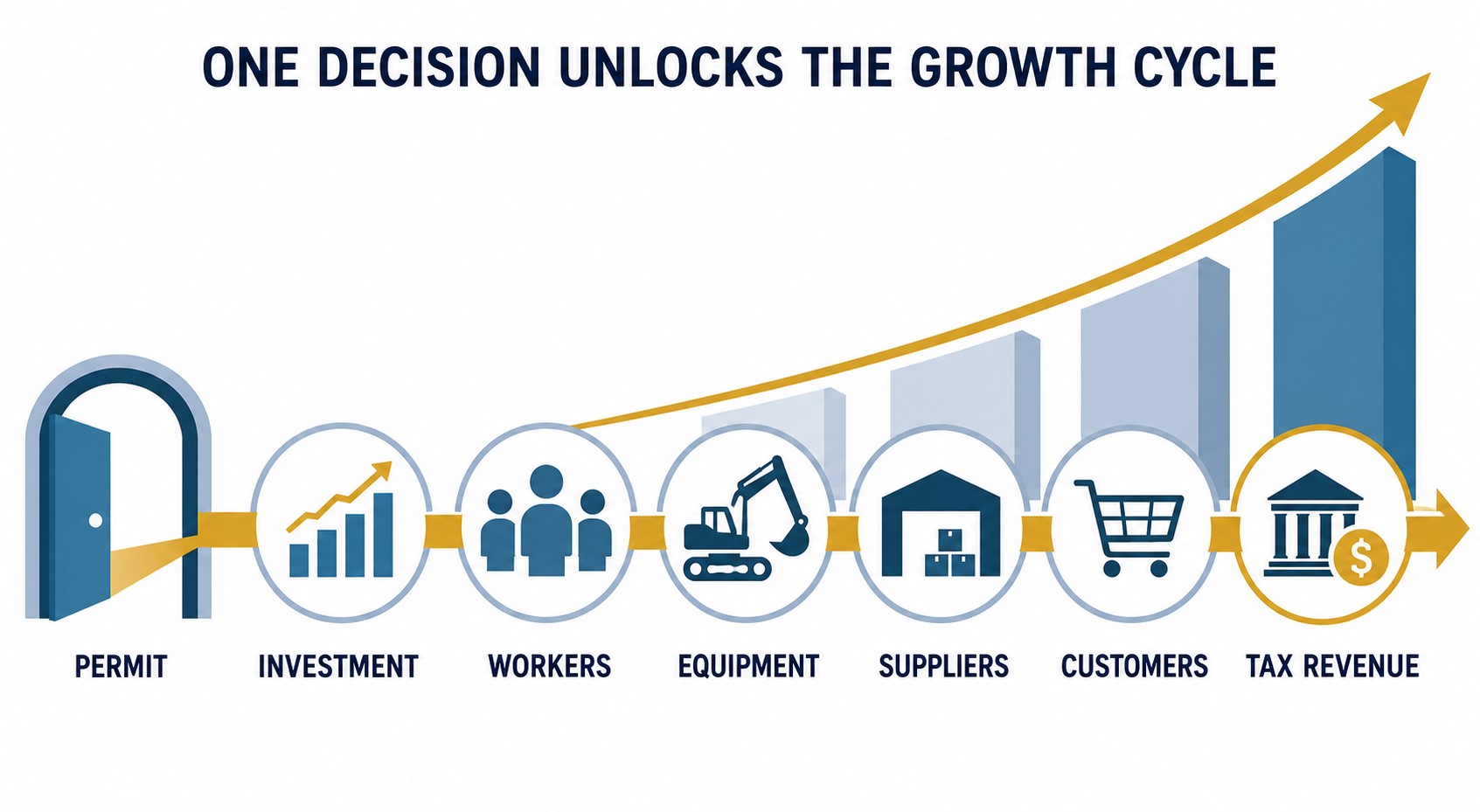
Large corporations can employ specialists, pursue multiple projects, and spread delay across much larger balance sheets. A small business may have its owner managing the application, its capital committed to one opportunity, and its growth dependent on one decision.
Permitting reform should begin with a simple objective: preserve legitimate public protections while reaching clear decisions within a timeframe the real economy can use. The first requirement is clarity.
Businesses should receive a complete list of requirements at the beginning of the process, along with a responsible point of contact and a reliable timetable. They should not discover new studies, interpretations, or approvals after committing capital based on the original instructions.
The second requirement is coordination. When federal, state, and local agencies participate in the same decision, one office should coordinate the review. An applicant should not have to submit the same information repeatedly or lose an earlier approval because another agency failed to act.
The third requirement is proportionality. Routine and low-risk projects that meet established standards should move through an expedited process. Agencies can focus greater scrutiny on complex proposals without forcing every investment through the same timeline.
The fourth requirement is accountability. Governments should publish median decision times, the age of pending applications, the number of additional information requests, and the percentage of decisions completed on schedule. They should also examine what prolonged delays cost in unrealized investment, employment, and tax revenue.
The Regulatory Flexibility Act already directs federal agencies to consider the effects of proposed rules on small entities and evaluate less burdensome alternatives. That same discipline should shape how regulations are administered, not only how they are written.
A regulatory system should be judged by the protections it provides and by whether businesses can understand it, navigate it, and receive timely decisions. Those goals are not in conflict. Clear standards and reliable administration strengthen both compliance and public confidence.
Permitting reform will not guarantee that every project succeeds. It will allow business owners to make decisions based on customers, costs, competition, and opportunity rather than an unpredictable government process.
The next article will examine how stable tax policy can help small businesses reinvest in equipment, technology, facilities, research, and employees. Before those investments can produce stronger growth, however, businesses need timely permission to put them to work.
Bring this economic perspective to your next leadership meeting or conference. Dan Varroney helps business and trade association leaders understand the forces shaping small-business investment, jobs and economic growth. Explore Dan’s small-business growth keynotes.
Dan Varroney is an economic growth strategist, founder and CEO of Potomac Core, and author of Rethinking Economic Growth.