
An industry ecosystem becomes valuable only when it changes the conditions limiting growth. Bringing the right organizations together is important, but a larger table does not guarantee a stronger industry. Without disciplined choices, an ecosystem can become another forum where participants exchange information, endorse broad goals, and leave without changing what businesses experience.

The first article in this series made the case for building the environment an industry needs to grow. The next challenge is deciding which parts of that environment the industry should work together to change.
Most industries do not lack issues. They face workforce shortages, regulatory complexity, infrastructure constraints, technology gaps, supply-chain vulnerabilities, and difficulty accessing capital. Treating every concern as a shared priority spreads resources too thinly to produce results.
This is where industry leadership differs from issue management. Issue management asks what needs attention now. Industry leadership asks which external conditions, if changed, would create the greatest opportunity for companies across the industry to invest, compete, and grow.
As I explain in Reimagining Industry Growth, sustained growth begins with an outside-in view. Leaders must understand how customers, suppliers, policymakers, educators, researchers, communities, and other stakeholders affect the industry’s ability to create value.
The process begins by defining the precompetitive growth opportunity. What could the industry achieve over the next three to five years if its most important external barriers were removed? The answer should be specific: accelerate domestic production, expand the skilled workforce, shorten facility approvals, increase technology adoption, or open new markets.
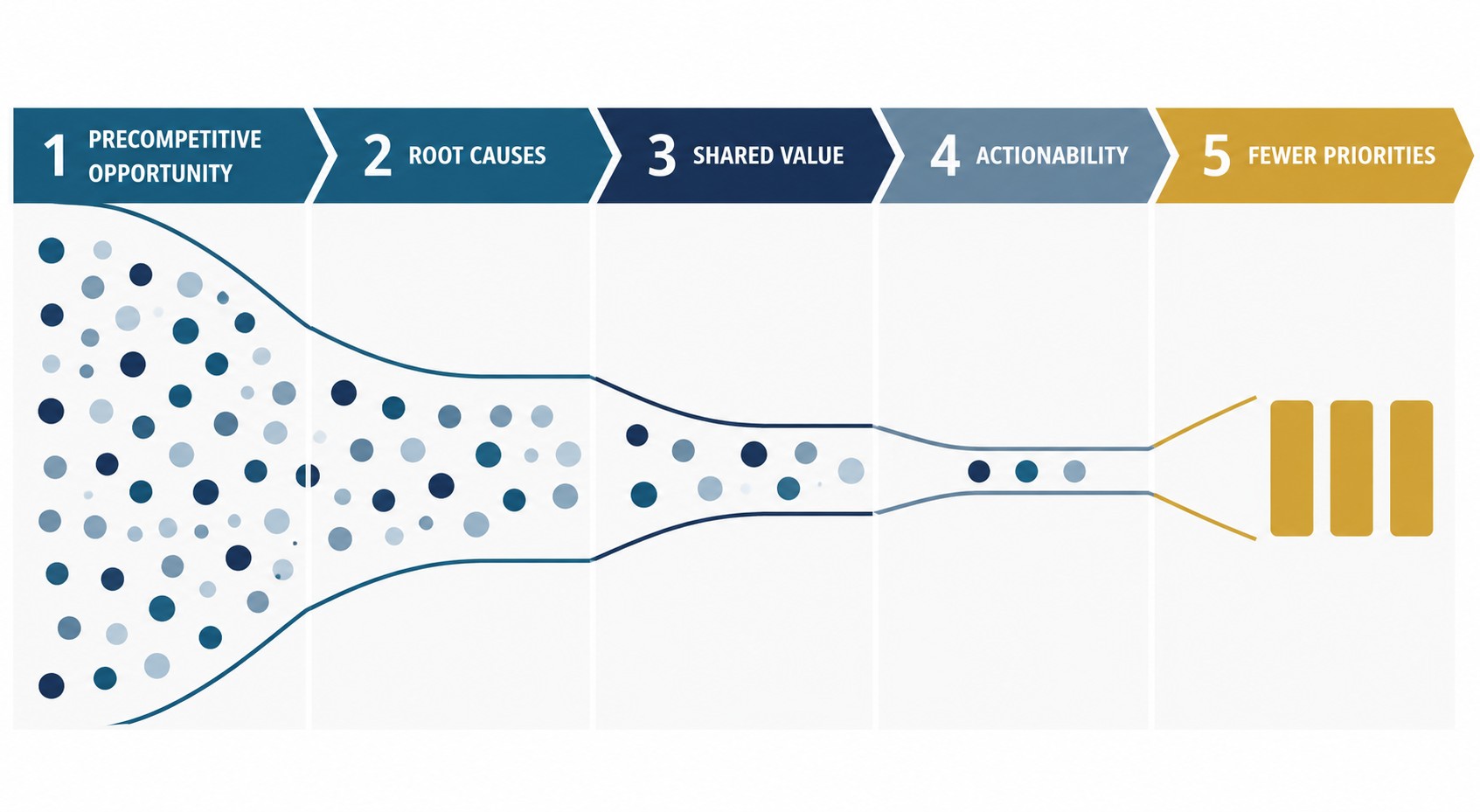
A clear growth opportunity changes the conversation. Instead of asking which problems deserve attention, leaders can ask which problems stand between the industry and that result.
The second step is identifying root causes rather than symptoms. A shortage of workers may appear to be a recruiting problem, but the deeper causes could include outdated training, limited awareness of career paths, geographic mismatch, licensing restrictions, or employers communicating different skill requirements. If the industry responds only with another recruitment campaign, the underlying constraint remains.
Leaders should trace each barrier through the ecosystem. What capability is missing? Who controls it? Which organizations are already working on the problem, and what prevents results at industry scale?
The third step is applying a shared-value test. A true industry priority should benefit a meaningful portion of the industry, require collective action, and create value beyond the interests of one company or market segment. If a company can solve the problem independently, it may be important, but it is not necessarily an ecosystem priority.
This test prevents the loudest voice or newest crisis from determining the agenda. It also assures smaller companies that shared resources address conditions that matter across the industry.
The fourth step is testing whether action is possible. Some barriers are too broad or poorly understood to become immediate priorities. Leaders should ask whether the industry has credible evidence, can identify the necessary decision-makers and partners, and can define progress over the next twelve to eighteen months.
This does not mean choosing only easy objectives. It means turning ambition into a sequence of achievable decisions. An industry may not be able to solve a national workforce shortage in one year, but it can establish common skill requirements, build partnerships in priority regions, and demonstrate a model that can be expanded.
The final step is choosing fewer priorities. Three well-defined objectives with committed leaders, resources, milestones, and measures will usually create more value than fifteen initiatives competing for attention. Every priority should have an accountable owner, a first action, a timetable, and a clear description of what will be different if the work succeeds.
Trade associations can lead this process because they see patterns no member can see alone. They can test whether a barrier is widely shared, identify the organizations capable of changing it, and align competitors around precompetitive needs.
That role requires more than collecting member concerns. The association must help industry leaders make choices, explain why some issues will receive greater attention, and connect advocacy, workforce, research, communications, and partnership strategies to the same growth outcomes.
The result should be a short industry growth agenda, not a catalogue of concerns. It should state the opportunity the industry is pursuing, the external conditions that must change, the few shared priorities that will change them, and the measures that will show whether the environment is improving.
Industries cannot build effective ecosystems around everything. They build them around the few challenges and opportunities important enough to require collective action. The discipline to choose those priorities is what turns a network of stakeholders into a platform for industry growth.
The next article will examine how to map influence across federal, state, and local levels. That work will ensure each shared priority reaches the people and institutions capable of moving it forward.
Bring this strategic conversation to your leadership team. Dan Varroney works with trade association boards and executives to strengthen alignment, relevance and industry growth. Explore Dan’s industry-growth speaking programs.
Dan Varroney is an economic growth strategist, founder and CEO of Potomac Core, and author of Reimagining Industry Growth and Rethinking Economic Growth.