
Business leaders are trained to focus on what they can control. They improve operations, develop talent, invest in technology, serve customers, and allocate capital. Those disciplines remain essential, but many of the most significant barriers to industry growth now sit outside any single company.
Workforce shortages cannot be solved by one employer. Regulatory complexity cannot be addressed by one compliance department. Infrastructure, access to capital, community acceptance, education, research, technology adoption, and public policy all depend on decisions made across a much wider network. Even well-managed companies can find their growth constrained by an external business environment that is fragmented, unpredictable, or unprepared.
That is why every industry needs an ecosystem strategy. An industry ecosystem is not another stakeholder list, coalition, or annual meeting. It is an organized approach to shaping the conditions an industry needs to grow. It connects companies, trade associations, educators, workforce organizations, financial institutions, researchers, community leaders, regulators, and elected officials around a small number of shared growth priorities.
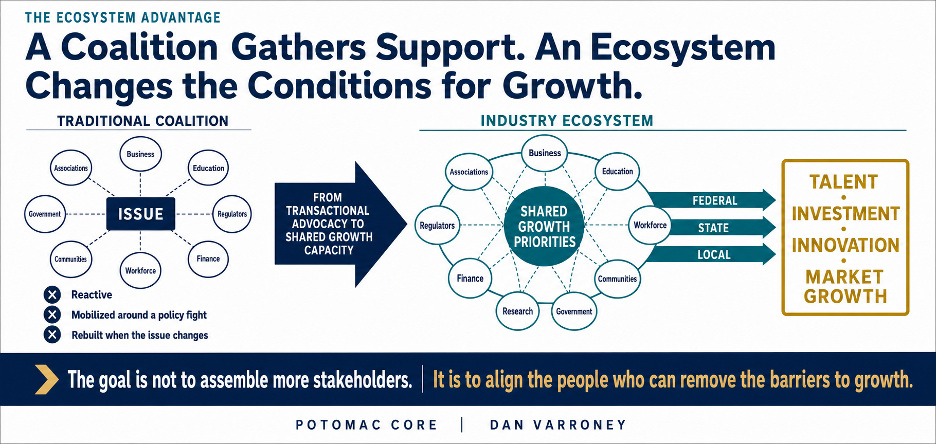
The distinction is important. Traditional advocacy often begins with a legislative or regulatory issue and mobilizes support around it. An ecosystem strategy begins with the industry’s long-term growth barriers and asks who has the authority, resources, relationships, and expertise to change them. Policy and advocacy remain central, but the work extends across federal, state, and local levels and continues regardless of which party is in power.
Consider workforce. Companies frequently compete for the same limited pool of skilled employees while schools and training providers struggle to understand what the industry will need five years from now. An ecosystem approach aligns employers around common skill requirements, connects them with educational institutions, creates clearer career pathways, and gives public officials a concrete reason to support training investments. No company has to surrender its competitive advantage to strengthen the talent pipeline everyone depends on.
The same logic applies to technology and infrastructure. A company may be ready to modernize, but permitting delays, energy constraints, broadband gaps, transportation bottlenecks, or limited financing can slow the investment. An industry that identifies those barriers collectively can engage the right decision-makers, assemble stronger evidence, and pursue solutions at the level where action is possible.
Trade associations are uniquely positioned to lead this work. They can see across companies, regions, and market segments. They have relationships with policymakers and partners. They can convene competitors around precompetitive challenges that no member can solve alone. But leading an ecosystem requires associations to move beyond coordinating activity. They must establish shared priorities, clarify the role of each partner, connect advocacy with workforce and innovation initiatives, and measure whether the external environment is actually improving. The first step is disciplined diagnosis. What outside conditions are most limiting the industry’s growth? Which are symptoms, and which are root causes? Where are existing relationships strong, and where are important voices missing? Which stakeholders can influence each barrier? What can be advanced nationally, and what requires state or local action?
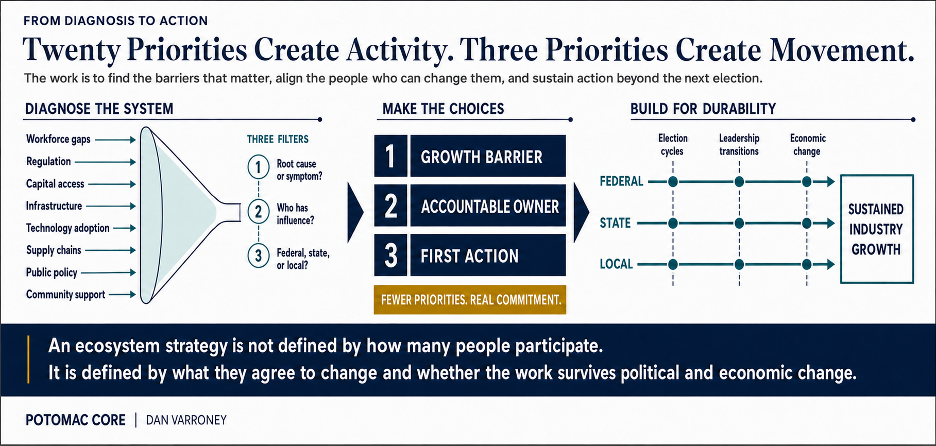
The next step is alignment. An effective ecosystem cannot pursue twenty priorities at once. Industry leaders must choose the few objectives that would materially improve growth, assign responsibility, commit resources, and establish the first actions. They must also decide how progress will be sustained through election cycles, leadership transitions, and changes in the economy.
This outside-in approach changes the role of industry leadership. Leaders still manage their organizations, but they also help shape the system surrounding them. They recognize that workforce, policy, infrastructure, capital, and public confidence are interconnected. They invest in relationships before a crisis requires them. They build influence through shared economic value rather than relying only on opposition to individual proposals.
Industries that do this well become harder to constrain and easier to support. Their partners understand the industry’s contribution. Policymakers see a practical growth agenda. Educators and workforce organizations know where to focus. Members experience value that no company could create independently.
The alternative is costly. When an industry remains fragmented, other actors define its future. Workforce dollars flow toward better-organized sectors. Infrastructure plans overlook needs. Regulations are written without operational insight. The result is not simply an advocacy failure. It is a strategic growth failure.
This article begins a series on how industries can build effective ecosystems. The next installments will examine how to choose shared priorities, map influence across federal, state, and local levels, turn trade associations into platforms for growth, and sustain collaboration when political leadership changes. The external business environment is not entirely controllable, but it is not fixed. Industries can shape it. The competitive question is whether they will build the ecosystem deliberately or continue reacting to barriers one issue at a time.
Continue the series: Choose the Priorities That Can Move an Entire Industry.
Bring this strategic conversation to your leadership team. Dan Varroney works with trade association boards and executives to strengthen alignment, relevance and industry growth. Explore Dan’s industry-growth speaking programs.
Dan Varroney is an economic strategist, founder and CEO of Potomac Core, and author of Reimagining Industry Growth, which explores strategic partnerships between businesses and trade associations.