

The most dangerous question during an investment boom may be whether the boom is real or a bubble. It invites a simple answer when economic transformations are rarely that simple.
A boom can create productive capacity while also producing excessive valuations, failed companies, and losses. Leaders must distinguish durable capabilities from investments that depend on expectations that may not hold.
The railroad expansion of the nineteenth century transformed American commerce, but it also attracted speculative capital and drove many companies into bankruptcy. The internet likewise transformed commerce while producing companies whose valuations bore little relationship to customers, revenue, or profitability.
Those failures did not reverse either transformation. They exposed the distance between financial expectations and economic value. The useful question today is what will remain valuable after expectations reset.
The United States is experiencing extraordinary investment in artificial intelligence, semiconductors, data centers, advanced manufacturing, energy, and domestic supply chains. Companies are constructing facilities, purchasing equipment, and competing for electricity, workers, and materials.
Real assets are being built, but that does not make every investment sound. Artificial intelligence may transform business while projects fail because capacity was misplaced, technology became obsolete, or customers would not pay enough.
Leaders can apply four tests to distinguish productive investment from expectations that have moved ahead of value. The first is whether customer adoption is beginning to catch up with capital investment.
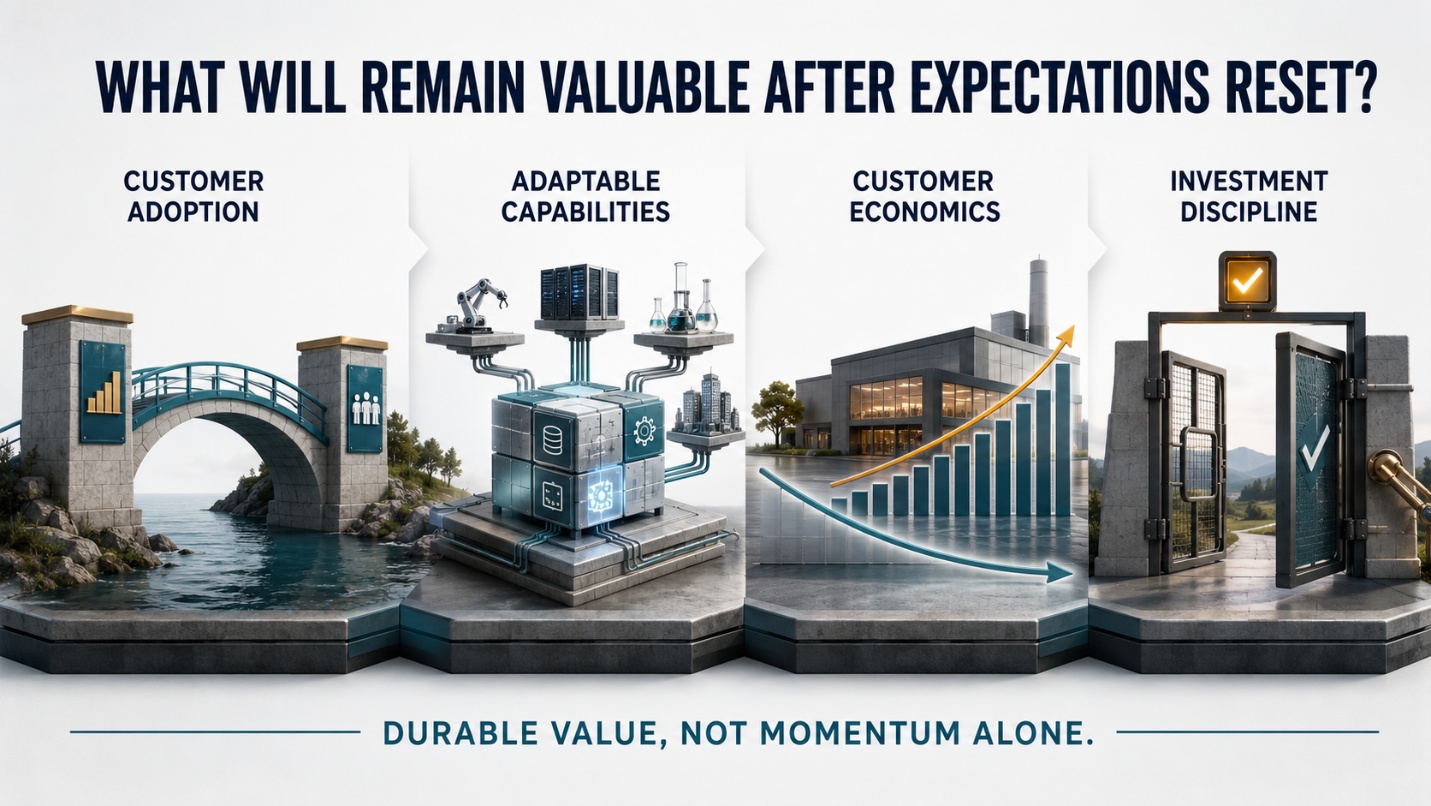
Business use of artificial intelligence is growing, but adoption remains limited compared with investment in computing capacity, semiconductors, and data centers. That gap does not prove a bubble exists because investment often must lead adoption. Railroads and broadband had to be built before businesses could realize their value.
The danger begins when investment outpaces adoption without a credible path toward paying demand. A pilot demonstrates interest, but value becomes clearer when customers progress to repeated use, achieve measurable results, and pay enough.
The second test is whether an investment creates capabilities that will remain useful if the original forecast proves too optimistic. Fiber-optic networks built during the internet boom retained value after technology stocks collapsed because new businesses and services eventually grew around them.
The same may be true of today’s data centers, semiconductor plants, energy systems, and advanced manufacturing facilities. An adaptable asset that can serve different customers, applications, and markets is more likely to retain value than one dependent on a single technology or growth assumption.
The third test is whether the investment strengthens the customer’s economics, not merely the technology provider’s revenue. Technology becomes an economic growth engine when businesses use it to increase output, lower costs, improve quality, serve customers more effectively, or create something previously impossible.
Selling the tools may initially be more profitable than using them. Demand for chips, servers, cooling systems, and software rises before productivity gains become visible, but that cannot remain the entire story.
Manufacturers must reduce downtime and increase output. Healthcare organizations must improve care, logistics companies must move goods more efficiently, and small businesses must gain new capabilities. If value remains concentrated among infrastructure providers, the boom will encounter its customers’ financial limits.
The final test is investment discipline. Leaders do not need certainty before acting, but they need a clear explanation of the problem an investment will solve, the capability it will create, and the evidence that would justify committing more capital.
They should also know what would cause them to slow down. Would the investment remain viable if adoption took twice as long, energy or financing costs increased, or a better technology emerged? Could the asset serve other customers if the original market failed to develop?
Trade associations can help their industries answer these questions by determining whether adoption is spreading beyond the largest companies and identifying shared barriers preventing businesses from realizing value. They can also distinguish isolated success stories from broader changes in industry performance.
America’s investment surge has many characteristics of a genuine economic transformation. New capacity is being created, businesses are adopting new tools, and technology is moving more deeply into physical industries. Failed companies, misplaced capital, and projects that never earn an adequate return will also be part of this period.
The leaders who navigate it successfully will understand what they are building, who will use it, how it will create measurable value, and why it will remain useful when the financial cycle turns. The boom can be real even when some bets are wrong, and the test is determining which investments are building the next economy and which depend on the boom never ending.
Related reading: Booms, Busts, and What Comes Next.
Bring this economic perspective to your next leadership meeting or conference. Dan Varroney helps business and trade association leaders understand the forces shaping investment, productivity and economic growth. Explore Dan’s economic keynote topics.
Dan Varroney is an economic strategist, founder and CEO of Potomac Core, and author of Rethinking Economic Growth.